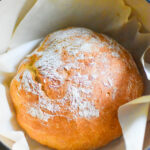
Easy Buttermilk Bread (No-Knead Recipe!)
Servings: 10 slices
Calories: 145kcal
Cozy, crusty bread you can enjoy the same day without even getting your hands dirty!
Print Recipe
Equipment
- 1 silicone spatula or kitchen spoon
- 1 spatula optional
- 1 4-quart Dutch oven or loaf tin (see notes)
- 1 food thermometer optional
Ingredients
- 3 cups bread flour
- 1 cup water warmed to 110-120 degrees Fahrenheit
- ½ cup buttermilk at room temperature
- 7 grams instant yeast typically one packet
- 1 teaspoon fine sea salt
Instructions
- Make the Dough: In a large mixing bowl, whisk the flour, yeast, and salt together. Pour in the water and stir until the ingredients start coming together, then mix in the buttermilk. Continue stirring until the mixture is uniform.The dough should look wet, sticky, and shaggy.3 cups bread flour, 1 cup water, 7 grams instant yeast, 1 teaspoon fine sea salt, ½ cup buttermilk
- Let it Rise: Cover the bowl loosely, and set aside in a warm spot until the dough has doubled in size (about 1 ½ - 2 hours depending on the temperature of your kitchen). The dough should have a foamy look (a little like focaccia) and feel tacky to the touch.
- Shape and Bake the Loaf: Preheat oven to 450 degrees Fahrenheit, and place lidded Dutch oven on the center rack so that it will get hot as the oven preheats.
- Turn prepared dough out onto a floured surface, and fold its edges in towards the center of the dough to form a round. Flip the dough over onto a sheet of parchment paper so that the folded part is now on the bottom, then slide it into the center of the parchment.I find it easiest to use a silicone spatula or kitchen spoon to fold in the edges of the dough, and a regular flat spatula dusted with flour to move the dough around on the parchment.
- Use the parchment paper to lift the dough and carefully place it into the heated Dutch oven, then cover with lid. Transfer the covered pot to the oven to bake for 30 minutes, then remove and bake for another 5-10 minutes, or until golden brown with an internal temperature of 190 degrees Fahrenheit.When checking the temperature of your loaf, be sure not to hit the pot with the probe, as that will give you an incorrect read.
- Finish and Serve: Carefully remove the bread from the pot, and let it cool on a cooling rack or cutting board for at least 10-15 minutes before slicing. Serve warm.
Notes
Chilling the Dough (optional)
Once the dough has risen, you can transfer the bowl to the refrigerator and chill overnight (up to 24 hours). When ready to bake, remove the dough from the fridge and let it sit at room temperature for about an hour before proceeding to step three of the recipe.
An additional chill gives the enzymes in the yeast and buttermilk more time to work, which results in a stronger fermented flavor in the finished bread. Refrigeration also makes the dough less sticky, so it's a little easier to handle.
Without a Dutch Oven (Method inspired by RecipeTin Eats)
Baking the bread in an enclosed pan allows the steam it releases to help cook it and create fluffiness. Here's how to achieve similar texture without using a Dutch oven:
- Place a large rectangular baking dish onto the bottom rack of the oven as it preheats.
- Meanwhile, bring a small saucepan or kettle of water to a boil.
- Once the oven is preheated, carefully pour the boiling water into the heated baking dish to create steam.
- Place the dough into a regular loaf pan, then palce then pan on the next rack above the pan of steaming water.
Nutrition
Calories: 145kcal | Carbohydrates: 28g | Protein: 5g | Fat: 1g | Saturated Fat: 0.3g | Polyunsaturated Fat: 0.3g | Monounsaturated Fat: 0.2g | Cholesterol: 1mg | Sodium: 247mg | Potassium: 60mg | Fiber: 1g | Sugar: 1g | Vitamin A: 21IU | Vitamin C: 0.002mg | Calcium: 20mg | Iron: 0.4mg
